 ContestLog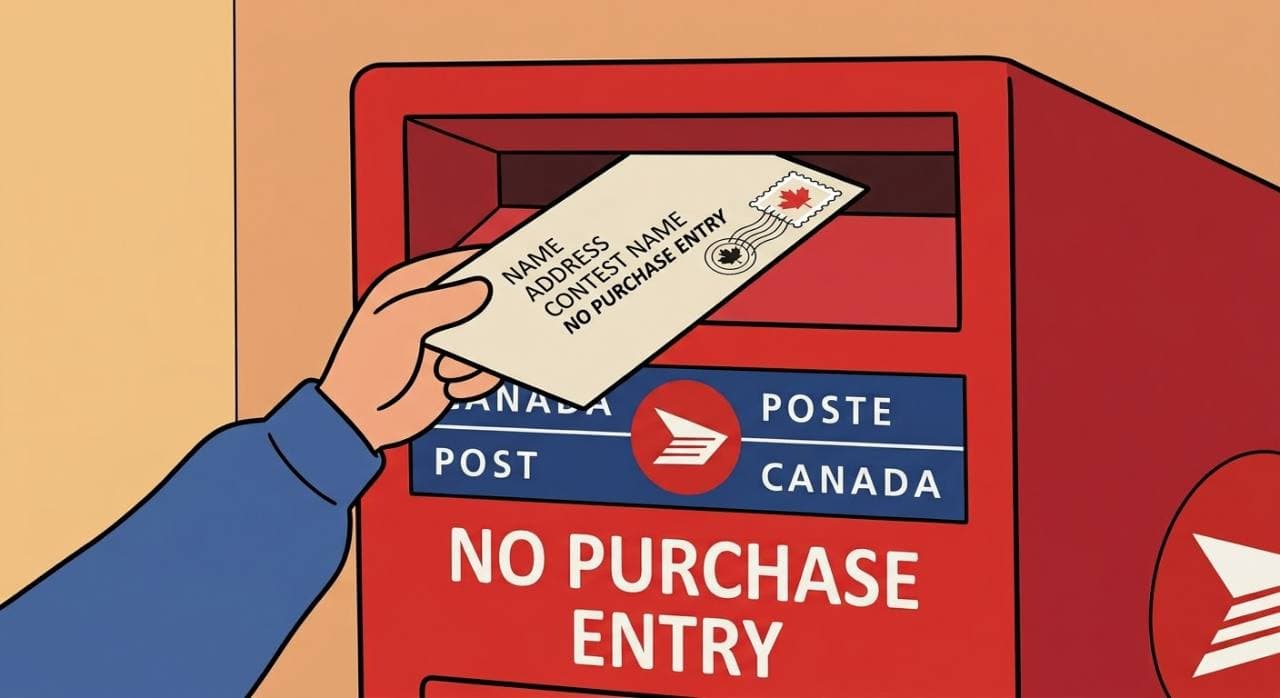
Some of the most appealing Canadian contests are advertised on product packaging or offer entries through a purchase code. That does not necessarily mean you have to buy the product to participate.
The official rules may provide a no-purchase-necessary method that lets eligible entrants receive the same kind of opportunity by completing an online form, sending an email, writing an original response, or mailing an entry.
I regularly use no-purchase entry methods and have won several contests through them. They can be worthwhile, but “no purchase necessary” does not always mean instant or effortless.
What does “no purchase necessary” mean?
A no-purchase entry method allows an eligible person to enter without buying the product or service connected to the promotion.
The Competition Bureau’s Promotional Contests Enforcement Guidelines discuss the Criminal Code restrictions involving games of chance where a participant pays money or provides other valuable consideration. The guidance explains that offering another entry route can remove the purchase requirement.
For entrants, the practical lesson is simple: when a contest appears to require a receipt, product PIN, or specially marked package, read the complete rules before deciding you cannot enter.
Search for headings such as:
- No Purchase Necessary
- No Purchase Entry
- Alternative Method of Entry
- AMOE
- Enter Without Purchase
- To Enter Without Making a Purchase
The alternative instructions are sometimes located several paragraphs below the advertised purchase method.
No-purchase entry is not a loophole
The free method is part of the official contest. It is not a trick, exploit, or way of avoiding the rules.
You must follow its instructions as carefully as someone using a purchased product code. The sponsor may specify:
- A separate entry form or email address
- Particular contact information
- A minimum or maximum word count
- A handwritten response
- A unique subject line
- One request per envelope or email
- A deadline earlier than the main contest closing date
- A limit per person, household, day, or entry period
An entry that ignores those requirements may not be eligible.
The main types of no-purchase entry methods
Online alternative-entry forms
These are the easiest no-purchase methods and the ones I am most likely to use.
The rules provide a separate web form where you enter your contact details and, depending on the contest, request a code or submit an entry directly. Sometimes the link is buried in the official rules rather than displayed on the main promotional page.
Save the confirmation page or email when one is provided. If the promotion permits repeat entries, note whether you may return daily, request another code, or complete the form only once.
Email entries
Some sponsors accept an email as the alternative entry. The rules may ask for your name, location, telephone number, the contest name, and a particular subject line.
An email entry may be as simple as providing the requested details, or it may require an original response or essay.
I have noticed more contests offering email-based alternatives recently. That is my observation from regularly reviewing Canadian rules, not a published industry statistic. For me, email is a welcome improvement because it removes postage and can leave a clear record in my sent folder.
Check whether automated replies are provided and keep your sent email until the contest is over.
Essays and original written responses
No-purchase methods sometimes require an original essay or response with a minimum word count. Examples I encounter commonly range from about 50 to 250 words.
The prompt might ask why you want the prize, what a brand or activity means to you, or how you would use the product. The rules may treat the response only as an entry requirement rather than judging its quality, but do not assume that—check how winners are selected.
Write the response yourself and answer the actual question. In the contest rules I review, the use of generative AI for these responses is almost always prohibited. Even when the rules do not mention AI explicitly, submitting machine-generated writing as your own may conflict with originality or authorship requirements.
Do not use AI to draft, rewrite, or expand the response when the rules prohibit it. A disqualified entry is not worth saving a few minutes.
Also verify:
- Minimum and maximum word counts
- Whether the response must be handwritten
- Required language
- Whether the same response may be reused
- Whether spelling and creativity are judged
- Whether rights to the submission are granted to the sponsor
Mail-in entries
Mail is the no-purchase method I use least often. I have entered only a handful of contests this way.
Although the contest does not require a product purchase, mail entry still costs money for stamps, envelopes, paper, and sometimes printing. The instructions may also require a handwritten essay, particular envelope dimensions, separate mailings for every entry, or a postmark well before the contest closes.
That makes mail entry a complete non-starter for many contesters. ContestLog highlights Mail NPE listings specifically so visitors can recognize them before investing time in the rules. The Explore Contests page also offers an Exclude Mail NPE filter for people who do not want these promotions in their results.
Why I am cautious about unconfirmed mail entries
With an online form or email, I usually have some evidence that I completed the process. Ordinary mail often provides no confirmation that the sponsor received or processed the entry.
For particularly valuable prizes designed to reward customers, that lack of visibility has always made me hesitant. I cannot establish that sponsors discard valid mailed entries, and entrants should not assume misconduct without evidence. My concern is more practical: if an ordinary envelope is delayed, lost, incomplete, or mishandled, I may never know.
Some rules provide a better process. They ask the entrant to mail a request and then send a unique contest code by email. I trust that structure more because the code provides evidence that the request was received and gives me something concrete to submit through the official contest system.
If a valuable contest offers only unconfirmed mail entry, decide whether the potential prize justifies the cost and effort. Registered or tracked mail may provide delivery evidence, but it can cost much more and does not replace compliance with every rule.
Are no-purchase entries treated the same as purchased entries?
Read the official rules rather than assuming.
Many promotions place all valid entries into the same draw or describe equivalent opportunities for each permitted entry. Others allocate entries, prizes, regions, or entry periods in a particular way.
Check:
- How many entries a purchase code provides
- How many entries the free method provides
- Whether the same overall limit applies to both methods
- Whether entry methods may be combined
- Whether prizes are allocated by method, region, or time period
- Whether a mailed request provides a code rather than an immediate entry
Do not exceed the total limit by using both methods unless the rules clearly permit it. A contest allowing one entry per person remains one entry per person even if several entry routes exist.
Follow the no-purchase deadline carefully
Mail-in and code-request deadlines may be earlier than the contest closing date.
For example, a promotion may close online on August 31 while requiring mailed requests to be postmarked by August 20 and received by August 25. That gives the administrator time to issue a code before online entry closes.
Record all relevant dates:
- The last day to request or mail an alternative entry
- The date the request must be received
- The deadline for using a supplied code
- The main contest closing date and time zone
Mailing an entry on the final contest day will not help when the rules required receipt a week earlier.
Common no-purchase entry mistakes
Small deviations can invalidate an otherwise legitimate entry.
Watch for:
- Sending the entry to the wrong postal or email address
- Using an incorrect email subject line
- Missing a required word count
- Typing a response that must be handwritten
- Putting multiple requests in one envelope when one is required
- Omitting age, province, telephone number, or another requested detail
- Requesting more codes than the entry limit permits
- Sharing a unique code that is tied to one entrant
- Missing the postmark or received-by deadline
- Using AI-generated writing when the rules prohibit it
- Assuming a code request automatically completes the entry
Create a simple checklist from the rules before submitting a complicated alternative entry.
When is a mail-in entry worth it?
I weigh the effort against the prize and the entry structure.
A mail entry may be worth considering when:
- The prize is particularly valuable or useful
- The promotion runs long enough to meet the mailing deadlines comfortably
- The required essay or handwriting is manageable
- The rules provide a confirmation or emailed code
- The total postage cost is reasonable
- The entry method may discourage casual participants
I am more likely to skip it when:
- Repeated entries require repeated postage
- The prize is modest
- The deadline is close
- The handwritten response is unusually time-consuming
- There is no confirmation and I am uncomfortable with the process
Other contesters may reach a different conclusion. ContestLog labels the method so you can decide for yourself rather than discovering the mailing requirement after opening the contest.
My no-purchase entry routine
When I find a purchase-linked promotion:
- Open the official rules.
- Search the page for “no purchase,” “alternative,” or “without purchase.”
- Identify whether the method is online, email, essay, or mail.
- Record the entry limit and every relevant deadline.
- Write any required response myself and check the word count.
- Save confirmation emails, screenshots, sent messages, or issued codes.
- Complete any second step required to turn a code request into an entry.
- Save repeat opportunities to the ContestLog tracker.
This process has produced real wins for me. No-purchase methods are not merely technical language hidden in the rules—they are legitimate entry routes worth checking.
The bottom line
You do not necessarily need to buy a product just because a contest is promoted through receipts, packaging, or purchase codes.
Online forms and email entries are usually the most convenient alternatives. Essays require more effort and should always be written according to the rules, especially when AI-generated content is prohibited. Mail entries add costs and uncertainty, which is why ContestLog highlights them and lets visitors filter them out.
Whatever method you choose, follow the official instructions exactly. A free entry submitted incorrectly is still an invalid entry.
Browse active Canadian contests, or read How to Win Contests in Canada: Advice From 16 Years of Entering for a complete contesting routine.
ContestLog provides general information for entrants and is not legal advice. Sponsors control entry methods, limits, eligibility, deadlines, and winner selection through their official rules.